Video Photo Studio
  • Video Studio
  • Photography Studio
  • Production
    • Interview Rec
    • Green Screen Production
    • Business Headshot
    • Actor Headshot
    • Artist Headshot
    • Musician Headshots
    • Commercial shoot
    • Interior shoot
Posted on August 8, 2024

Acting exercises that build emotional truth, observation skills, non-verbal communication, imaginary object work, and improvisation for performers. Pair training with professional actor headshots when updating casting materials.

Acting Exercises That Build Emotional Truth, Observation, and Improvisation Skills

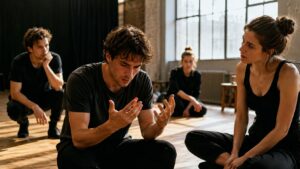
Young actors practicing the Stanislavsky Method during a theater rehearsal, focusing on emotional preparation, observation, and authentic performance in a professional acting studio.
Actors rehearse Stanislavsky exercises that develop emotional truth, observation, and authentic stage performance.

Table of Contents

  • Why Do Actors Build Circumstances Before Acting?
    • Engagement with Dynamic and Static Entities
    • Collaborative Scene Development
    • Multi-Sensory Object Interaction
    • Reflective Interaction with Past Experiences
  • How Does Emotional Context Change Physical Actions?
    • Exercises on Object-Related Interactions and Emotional Attunement
    • Task 1: Bandaging a Wounded Arm
    • Task 2: Helping with Outerwear
    • Task 3: Returning Home
    • Task 4: Greeting New Arrivals
    • Task 5: Initiating a Greeting
  • How Can Non-Verbal Communication Tell a Story?
    • Exercises on Non-Verbal Physical Communication
    • Fishing Scenario
    • Window Conversation
    • In-Class Communication
    • Hospital Communication
  • How Do Imaginary Objects Improve Physical Performance?
    • Exercises on Non-Verbal Communication and Physical Interaction Dynamics
    • Exercise 1: Manual Dexterity in Everyday Tasks
    • Exercise 2: Constructive Imagination
    • Exercise 3: Interaction with Imaginary Animals
  • How Does Improvisation Improve Acting Skills?
    • Exercise 1: Dynamic Mirroring
    • Exercise 2: Delayed Mirroring
    • Exercise 3: Mirroring with Associative Play
    • Exercise 4: Sculptural Group Dynamics
  • Frequently Asked Questions
  • Related Reading


Why Do Actors Build Circumstances Before Acting?

Engagement with Dynamic and Static Entities

Diagram illustrating the Stanislavsky actor preparation process from imagination and emotional memory to physical action and authentic performance.
Emotional preparation transforms imagination into believable stage performance.

Before any exchange begins, build a vivid situational context. Draw on emotional memory and imagination to evoke specific feelings and thoughts. Once this preparation is complete, set clear objectives for the interaction—for example: (a) reading the emotional state of everyone in the room; (b) examining details such as sketches for an upcoming performance, a new tablecloth, or a new neighbor’s outfit.

Collaborative Scene Development

Have two participants take spontaneous positions in the space, triggered by a simple cue such as a dropped cotton ball. Each participant interprets and justifies the resulting dynamic, building appropriate circumstances for the interaction. As the exercise develops, participants observe one another and work to understand and justify each other’s actions, gradually bringing their behavior into alignment toward a shared objective.

Multi-Sensory Object Interaction

Infographic showing how sight, hearing, touch, smell, and memory help actors create believable performances using the Stanislavsky Method.
The five senses help actors create truthful emotional experiences on stage.

Engage with objects using all five senses to sharpen perception: (a) look and listen to the world outside a window, opening it if possible to extend the sensory experience; (b) identify the different smells in an indoor space or a garden.

Reflective Interaction with Past Experiences

Lead a reflective dialogue about objects or experiences from the past: (a) recall and discuss the previous day’s events; (b) revisit memories of a recent art exhibition, museum visit, or a seasonal fashion showroom; (c) reflect on the work of favorite artists, encouraging deeper engagement with what was seen.

Together, these exercises build a nuanced understanding of interactions with both people and objects, emphasizing context, emotional resonance, and collaborative interpretation in theatrical practice.

See also:
Emotional context and physical actions ·
Multi-sensory object interaction ·
Collaborative scene development ·
FAQ: building circumstances

↑ Back to Table of Contents


How Does Emotional Context Change Physical Actions?

Exercises on Object-Related Interactions and Emotional Attunement

Comparison table demonstrating how identical physical actions change when emotional objectives and relationships between characters differ.
The same physical action creates different performances depending on emotional intention.

These exercises show how emotional context shapes interactions with objects, since the same object can call up very different attitudes and emotions depending on the situation.

Task 1: Bandaging a Wounded Arm

  • Scenario A: Give first aid to a famous person.
  • Scenario B: Help a close friend with a wound.
  • Scenario C: Care for someone who has hurt you emotionally.

Note: The task—bandaging an arm—stays the same, but the emotional engagement and approach should shift depending on your relationship with the recipient.

Task 2: Helping with Outerwear

  • Scenario A: Offer a coat to a widely respected teacher.
  • Scenario B: Help a friend into her jacket.
  • Scenario C: Help a sister you’re currently at odds with.

Task 3: Returning Home

  • Scenario A: Return home to your mother after a long absence.
  • Scenario B: Return to a brother’s home where you’re unwelcome.
  • Scenario C: Return to a friend’s home hoping to reconcile after a falling-out.

Task 4: Greeting New Arrivals

  • Scenario A: Welcome a friend home from a long business trip.
  • Scenario B: Receive your employer at your home.
  • Scenario C: Host an uninvited, tiresome visitor.

Task 5: Initiating a Greeting

  • Scenario A: Greet someone you owe a debt you can’t pay off anytime soon.
  • Scenario B: Say hello to an elderly neighbor.
  • Scenario C: Greet the rector of your institute.
See also:
Bandaging task ·
Non-verbal storytelling ·
Dynamic and static entities ·
FAQ: same task, different emotion

↑ Back to Table of Contents


How Can Non-Verbal Communication Tell a Story?

Exercises on Non-Verbal Physical Communication

Two actors communicating without words through eye contact, facial expressions, posture, and hand gestures during a Stanislavsky acting exercise.
Non-verbal communication develops truthful partner interaction and emotional connection.

These exercises emphasize the role of non-verbal cues in maintaining “organic silence“—communication that doesn’t disrupt the scene.

Fishing Scenario

A fisherman sitting by the river with his rod notices a girl singing loudly nearby. He must signal to her—without words—to keep her distance so she doesn’t scare off the fish.

Window Conversation

Through a closed window, invite a girl on a date using only visual communication.

In-Class Communication

During a lecture, one student silently asks another—seated in a different row—for help, using discreet signals.

Hospital Communication

A patient who can’t speak and has only one working hand needs to ask the nurse for a pen and paper to write a note.

These exercises explore how human interaction shifts under different emotional and physical constraints, showing how context and relationships shape behavior and communication.

See also:
Fishing scenario ·
Hospital communication ·
Manual dexterity exercises ·
FAQ: organic silence

↑ Back to Table of Contents


How Do Imaginary Objects Improve Physical Performance?

Exercises on Non-Verbal Communication and Physical Interaction Dynamics

Exercise 1: Manual Dexterity in Everyday Tasks

“Painting the Fence”: Mime painting a fence using your hands instead of a brush, exploring different ways to build hand agility:

  • Smooth hand waves that sweep across the body, from one shoulder to the other
  • Touching and feeling an “invisible wall”
  • Rowing with invisible oars
  • Wringing out wet laundry
  • A tug-of-war with an invisible rope

Exercise 2: Constructive Imagination

Workflow diagram illustrating how actors imagine an object, perceive its size, weight, and texture, execute movement, and convince the audience.
Constructive imagination transforms invisible objects into believable stage reality.

“Piece by Piece”: Assemble a complex object—a bicycle, a helicopter, an airplane, or a boat built from planks—using entirely invisible parts. Each movement should convincingly convey the size, weight, and shape of the part to the observer, sharpening the plasticity of movement and the clarity of intention.

Exercise 3: Interaction with Imaginary Animals

“Petting the Animal”: Pet, lift, feed, and cage various animals. The observer should be able to tell whether the animal is a fluffy rabbit, a slippery snake, a small mouse, or a large elephant based on your gestures alone.

See also:
Multi-sensory object interaction ·
Constructive imagination ·
Improvisation exercises ·
FAQ: imaginary objects

↑ Back to Table of Contents


How Does Improvisation Improve Acting Skills?

Improvisation Exercises: Enhancing Attention and Spontaneity

Exercise 1: Dynamic Mirroring

Four-step image sequence showing two actors practicing the Mirror exercise through leadership, imitation, synchronized movement, and role reversal.
Mirroring exercises strengthen observation, timing, and partner awareness.

Participants pair up and face each other about a meter apart, taking on the roles of Presenter and Reflection. The Presenter initiates movements—both everyday and abstract—which the Reflection mirrors in real time. The goal is a fluid, attuned interaction: no rushing, and the Reflection stays in sync with the Presenter. At any moment, either partner can take the initiative and become the Presenter, which keeps both participants flexible and responsive to role changes.

Exercise 2: Delayed Mirroring

This variation follows the same structure as the first exercise but adds a one-second delay: the Reflection replicates the Leader’s movements just a beat behind. The delay pushes participants to sharpen their attention and anticipation, since the Reflection has to watch closely and time each response.

Exercise 3: Mirroring with Associative Play

This exercise layers a word-association game onto the basic mirroring activity. While one participant mirrors the other’s movements, both engage in a spontaneous association game, naming nouns that logically connect to one another (table, chair, furniture, and so on). Splitting attention between physical mimicry and verbal association builds multitasking ability.

Exercise 4: Sculptural Group Dynamics

Best suited to groups of three, this exercise has participants take turns adopting and adjusting poses to build a collective sculpture. The first person sets a pose, and the second and third add to the formation in turn. Roles rotate around the group, which rewards quick, spontaneous decision-making and adaptability. Variations include:

  • Thematic Sculptures: Build sculptures around a set theme, such as summer or the underwater world, encouraging imaginative and thematic expression.
  • Sonorous Sculptures: Pair each sculpture with a sound or word, combining physical expression with an auditory element and turning the exercise into a movement-based association game.

Together, these exercises build associative thinking, sharpen spontaneous reactions, and expand each participant’s range of expressive movement.

Workflow infographic showing the progression of improvisation training from observation and partner awareness to authentic collaborative performance.
Improvisation develops through observation, collaboration, and authentic performance.

Conclusion

Great acting begins long before the first line is spoken. It starts with observation, imagination, emotional truth, and a clear objective. The exercises in this guide demonstrate how seemingly simple tasks—interacting with an object, communicating without words, or responding to a partner—can develop the core skills that make every performance believable.

Whether you’re an actor, model, musician, or performing artist, consistent practice of these techniques will strengthen your ability to stay present, respond authentically, and create meaningful connections with both your scene partners and your audience. Over time, these foundational exercises become more than rehearsal tools—they become habits that support confident, truthful, and expressive performances on stage, on camera, and in every professional creative environment.

See also:
Dynamic mirroring ·
Sculptural group dynamics ·
Collaborative scene development ·
FAQ: mirroring

↑ Back to Table of Contents


Frequently Asked Questions

Why do actors build circumstances before acting?
Actors build a vivid situational context using emotional memory and imagination, then set clear interaction objectives—such as reading emotional states in the room or examining specific environmental details. See why actors build circumstances and engagement with dynamic and static entities.
How does emotional context change physical actions?
The same physical task can evoke very different attitudes depending on relationship and situation. Exercises like bandaging an arm, helping with outerwear, or greeting arrivals keep the action constant while shifting emotional engagement. See emotional context and physical actions and Task 1: Bandaging a Wounded Arm.
How can non-verbal communication tell a story?
Non-verbal cues maintain “organic silence”—communication that doesn’t disrupt the scene. Scenarios include silent fishing signals, inviting someone on a date through a closed window, discreet classroom requests, and limited-mobility hospital communication. See non-verbal storytelling and the fishing scenario.
What is organic silence in acting exercises?
Organic silence is communication through non-verbal cues that keeps the scene intact without spoken words. Practice it in the non-verbal physical communication exercises, including window conversation and hospital communication.
How do imaginary objects improve physical performance?
Working with invisible objects trains hand agility, clarity of intention, and believable weight and shape—through exercises like painting a fence with bare hands, assembling imaginary machines, and interacting with imaginary animals. See imaginary object performance and constructive imagination.
How does improvisation improve acting skills?
Improvisation exercises enhance attention and spontaneity through mirroring, delayed response, associative play, and sculptural group dynamics. Together they build associative thinking, sharper reactions, and a wider expressive range. See improvisation exercises and sculptural group dynamics.
What is mirroring in acting training?
In dynamic mirroring, one partner leads movements while the other reflects them in real time; roles can switch at any moment. Delayed mirroring adds a one-second lag, and associative play layers word association onto physical mimicry. See dynamic mirroring, delayed mirroring, and mirroring with associative play.
Why practice the same task with different emotional scenarios?
Keeping the physical task identical while changing the relationship—famous person, close friend, or someone who hurt you—forces actors to adjust emotional engagement and approach without changing the action itself. See object-related emotional attunement and Task 5: Initiating a Greeting.

↑ Back to TopTable of ContentsFAQRelated Articles

Actors practicing the Stanislavsky Method during a professional theater rehearsal focused on emotional preparation and authentic performance.

Frequently Asked Questions

  • Why do actors build circumstances before acting?
  • How does emotional context change physical actions?
  • How can non-verbal communication tell a story?
  • What is organic silence in acting exercises?
  • How do imaginary objects improve physical performance?
  • How does improvisation improve acting skills?
  • What is mirroring in acting training?
  • Why practice the same task with different emotional scenarios?

Previous Post
Elements of Acting in Photoposition
Next Post
Chroma Key Technology and Green / Blue Screen in Film Production
The Complete Guide to Group Portrait Photography: Posing, Lighting & Camera Settings

The Complete Guide to Group Portrait Photography: Posin…

1 month ago
Night Landscape Photography: City Lights, Fireworks, Lightning & Professional Workflow

Night Landscape Photography: City Lights, Fireworks, Li…

1 month ago
Night Landscape Photography: Camera Settings, Moonlight & Pro Tips

Night Landscape Photography: Camera Settings, Moonlight…

1 month ago
Let’s Connect
Facebook
Twitter
Pinterest
Instagram
Telegram
37 West 26th st. NYC, NY 10010
gatsbystage@gmail.com
347-858-5857
Fill out this field
Fill out this field
Please enter a valid email address.
Fill out this field
ARTIST HEADSHOT
COMMERCIAL SHOOT
MODEL TEST
INTERIOR SHOOT
ACTOR HEADSHOT
MEDICAL HEADSHOT
INDUSTRIAL SHOOT
BUSINESS SHOOT
MUSICIAN HEADSHOT
PODCAST RECORDING
INTERVIEW RECORDING
GREEN SCREEN PRODUCTION
PHOTO STUDIO RENTAL
VIDEO STUDIO RENTAL
BLOG
REQUEST
STUDIO POLICY
PRODUCTIONS

          Useful information about working in the studio from the blog

+1 (347) 858-5857
37 W 26th St studio 315, New York, NY 10010
2025 All Rights Reserved