


Video Photo Studio
  • Video Studio
  • Photography Studio
  • Production
    • Interview Production
    • Green Screen Production
    • Business Headshot
    • Actor Headshot
    • Artist Headshot
    • Musician Headshots
    • Commercial shoot
    • Interior shoot
Posted on 18 Jul at 1:28 am

Landscape Photography Composition: Professional Techniques for Better Photos

Learn how professional photographers compose landscape images using foreground, leading lines, depth, visual hierarchy, and camera position to create stronger, more compelling photographs.

Landscape Photography Composition: Professional Techniques for Creating Stronger Images

Table of Contents

  • Introduction
  • What Makes a Strong Landscape Composition?
  • Build Visual Hierarchy
  • Learn to See a Photograph, Not Just a Place
  • Choose a Clear Subject
  • Simplify the Composition
  • Lens Choice and Camera Position
  • Work the Scene
  • Professional Workflow Checklist
  • Continue Learning

Introduction

Landscape photography composition diagram illustrating foreground, middle ground, background, and viewer eye flow.
Professional landscape photography composition diagram showing foreground, middle ground, background, and viewer eye movement.

Beautiful landscapes are everywhere. Memorable landscape photographs are not.

A photograph can be technically sharp and correctly exposed yet still feel weak if the composition does not guide the viewer’s attention.

Composition determines what the viewer sees first, how the eye moves through the frame, and which elements support the main subject.

Professional landscape photographers therefore spend time studying a scene before taking photographs. They evaluate light, foreground possibilities, distractions, camera position, focal length, and relationships between objects.

Modern cameras, RAW files, drones, focus stacking, GPS scouting, and editing software have changed how photographers work, but they have not replaced good composition.

Technology can improve an image. It cannot rescue a weak visual structure.


What Makes a Strong Landscape Composition?

Comparison showing why scenery alone does not create a strong composition.
Illustration explaining the difference between beautiful scenery and effective photographic composition.

Spectacular scenery does not automatically create a strong photograph.

When we look at a landscape in person, our eyes continuously scan the scene and our brain ignores many distractions. A camera records everything inside the frame.

Professional photographers compensate for this by deciding what deserves attention and simplifying everything around it.

A strong landscape photograph should quickly answer three questions:

  • What is the main subject?
  • Why should the viewer notice it?
  • Where should the viewer look next?

If too many elements compete for attention, the composition usually feels confused.


Build Visual Hierarchy

Panoramic mountain landscape illustrating visual hierarchy.
Landscape demonstrating primary subject, supporting elements, and background.

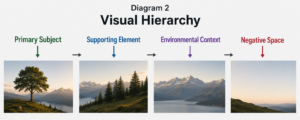
Visual hierarchy is the arrangement of elements so the viewer notices the most important subject first and then moves naturally through the rest of the photograph.

A useful structure is:

  • Primary subject — the element that attracts attention first.
  • Supporting elements — shapes, lines, reflections, or objects that reinforce the subject.
  • Background — context that adds atmosphere without becoming a distraction.

For example:

Primary subject: mountain peak
Supporting element: river leading toward the mountain
Background: clouds illuminated by sunrise

Each layer should support the image rather than compete with the others.

Building visual hierarchy diagram.
Diagram showing how primary subjects, supporting elements, and background work together.

Learn to See a Photograph, Not Just a Place

Professional observation checklist before taking a landscape photograph.
Photographers analyze light, shape, pattern, perspective, and depth before choosing a composition.

Experienced photographers learn to stop thinking only about the location and start seeing visual relationships.

Look for:

  • light and shadow
  • shape and line
  • texture and pattern
  • contrast and color
  • negative space
  • perspective and depth

Before setting up a tripod, ask:

  • What attracts my eye first?
  • What is distracting?
  • Can the composition be simplified?
  • Would another camera position improve the scene?
  • Would a longer or wider focal length strengthen the subject?

These questions turn photography from simply recording a place into deliberately designing an image.


Choose a Clear Subject

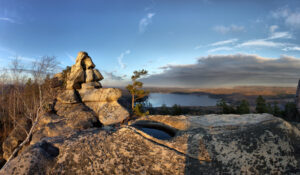
Choosing a clear subject in landscape photography.
Simple subjects often create stronger landscape compositions than visually crowded scenes.

Every successful landscape photograph needs a clear subject.

That subject does not have to be dramatic. Strong compositions can be built around:

  • a tree
  • a river
  • a trail
  • rocks
  • mist
  • reflections
  • sand dunes
  • a cabin
  • cloud formations

What matters is not how spectacular the subject is, but whether it organizes the frame and gives the viewer a clear place to look.


Simplify the Composition

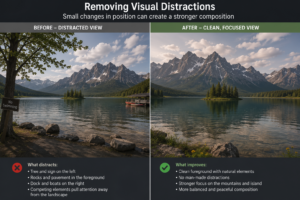
Removing visual distractions from a landscape composition.
Changing camera position can remove distractions and strengthen the subject.

Professional landscape photography is often about removing unnecessary elements.

Common distractions include:

  • utility poles
  • road signs
  • vehicles
  • random branches
  • bright objects
  • clipped tree trunks
  • people unintentionally entering the frame

Inspect all four edges of the frame before taking the photograph.

If something does not contribute to the image, try changing camera position, focal length, height, or crop.

The goal is simple: reduce visual competition so the viewer immediately understands the photograph.

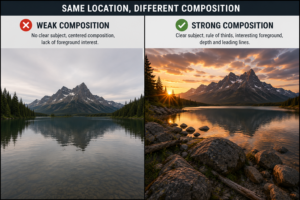
Comparison of weak and strong landscape compositions.
Side-by-side comparison demonstrating a cleaner composition from the same location.

Lens Choice and Camera Position

Wide-angle versus telephoto composition comparison.
Different focal lengths can dramatically change the relationships between landscape elements.

Many photographers automatically reach for an ultra-wide lens when photographing landscapes.

That is not always the best choice.

Wide lenses include more of the scene but can make distant subjects appear smaller and increase visual clutter.

Moderate and telephoto focal lengths can simplify complex scenes, isolate subjects, and strengthen relationships between distant elements.

Camera position can be even more important than focal length.

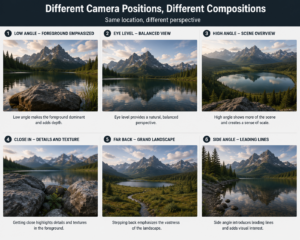
Moving a few feet left or right, lowering the camera, or gaining a slightly higher position can remove overlapping objects and completely change the balance of the photograph.

Professional Tip

Before setting up your tripod, walk around the location and compare several viewpoints.

Try changing camera height, distance, and focal length before deciding on the final composition.


Work the Scene Instead of Taking One Photograph

Camera position comparison.
Exploring multiple viewpoints helps photographers find the strongest composition.

Professional photographers rarely arrive at a location, make one exposure, and leave.

They work the scene.

A practical approach is to:

  • walk around before setting up the tripod
  • compare low and eye-level viewpoints
  • move closer and farther away
  • test wide, standard, and telephoto focal lengths
  • look for stronger foreground elements
  • check the edges of the frame
  • wait for changing light or weather when necessary

The strongest photograph is often the result of several small refinements rather than one lucky exposure.


Professional Workflow Checklist

StepStageKey Action
1Research LocationStudy access, viewpoints, foreground opportunities, and possible compositions.
2Check ConditionsReview weather, visibility, sunrise, sunset, and sun direction.
3Scout the SceneLook for subjects, leading lines, clean backgrounds, reflections, and depth.
4Choose Camera PositionCompare height, distance, orientation, and viewpoint before setting the tripod.
5Select Focal LengthCompare wide, normal, and telephoto perspectives.
6Build CompositionOrganize the main subject, supporting elements, foreground, and background.
7Remove DistractionsInspect the frame edges and eliminate unnecessary visual elements.
8Camera SettingsSet aperture, shutter speed, ISO, focus, white balance, and exposure.
9Capture VariationsPhotograph several compositions, focal lengths, and exposures.
10Edit and DeliverSelect the strongest images, process RAW files, and export for their intended use.

Composition should usually be solved before exposure. A technically perfect exposure cannot compensate for a confused composition.


Continue Learning

Landscape composition is one part of professional landscape photography. Light, exposure, filtration, weather, and field workflow also influence the final result.

Future articles in this series will cover:

  • Landscape Photography Lighting: How Professionals Work with Natural Light
  • Landscape Camera Settings: Exposure, Filters, and Professional Workflow
  • Night Landscape Photography: Moonlight, City Lights, Fireworks, and Long Exposure Techniques

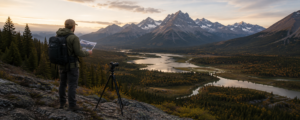
Professional photographer composing a mountain landscape during sunrise using a tripod and mirrorless camera

Frequently Asked Questions


What makes a strong landscape composition?

A strong composition has a clear subject, visual hierarchy, depth, and supporting elements that naturally guide the viewer through the frame. Read the full explanation.

What is visual hierarchy in landscape photography?

Visual hierarchy organizes the scene so the viewer notices the primary subject first, then supporting elements, and finally the background. Learn more.

How do photographers create depth in landscape photography?

Professionals build depth by arranging foreground, middle ground, and background. See the section.

Should I use a wide-angle or telephoto lens?

Read the comparison.

How do professionals choose a landscape subject?

See the section.

What is visual noise?

Learn how to eliminate distractions.

Why is simplicity important?

Read more.

Why does camera position matter?

See the explanation.

What is the professional workflow?

View the checklist.

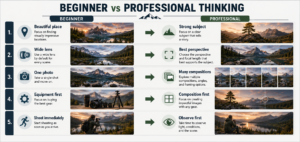
What is the biggest beginner mistake?

Read more.


Previous Post
Industrial Macro Photography: How to Photograph Machine Parts and Engineering Components
Next Post
What Time of Day Produces the Best Landscape Photos? A Professional Guide to Natural Light
The Complete Guide to Group Portrait Photography: Posing, Lighting & Camera Settings

The Complete Guide to Group Portrait Photography: Posin…

3 months ago
Night Landscape Photography: City Lights, Fireworks, Lightning & Professional Workflow

Night Landscape Photography: City Lights, Fireworks, Li…

3 months ago
Night Landscape Photography: Camera Settings, Moonlight & Pro Tips

Night Landscape Photography: Camera Settings, Moonlight…

3 months ago
Let’s Connect
Facebook
Twitter
Pinterest
Instagram
Telegram
37 West 26th Street, Studio 315, New York, NY 10010
gatsbystage@gmail.com
+1 (347) 858-5857
Fill out this field
Fill out this field
Please enter a valid email address.
Fill out this field
ARTIST HEADSHOT
COMMERCIAL SHOOT
MODEL TEST
INTERIOR SHOOT
ACTOR HEADSHOT
MEDICAL HEADSHOT
INDUSTRIAL SHOOT
BUSINESS SHOOT
MUSICIAN HEADSHOT
PODCAST RECORDING
INTERVIEW PRODUCTION
GREEN SCREEN PRODUCTION
PHOTO STUDIO RENTAL
VIDEO STUDIO RENTAL
BLOG
CONTACT
STUDIO POLICY
PRODUCTIONS

        Useful Information About Working in the Studio From the Blog

+1 (347) 858-5857
37 West 26th Street, Studio 315, New York, NY 10010
2026 All Rights Reserved