

Video Photo Studio
  • Video Studio
  • Photography Studio
  • Production
    • Podcast / Interview Rec
    • Green Screen Production
    • Business Headshot
    • Actor Headshot
    • Artist Headshot
    • Musician Headshots
    • Commercial shoot
    • Interior shoot
Posted on 18 Jul at 1:28 am

Landscape Photography Composition: Professional Techniques for Better Photos

Learn how professional photographers compose landscape images using foreground, leading lines, depth, visual hierarchy, and camera position to create stronger, more compelling photographs.

Landscape Photography Composition: Professional Techniques for Creating Stronger Images

Table of Contents

  • Introduction
  • What Makes a Strong Landscape Composition?
  • Composition Is Visual Communication
  • What Is Visual Hierarchy?
  • The Difference Between Seeing a Place and Seeing a Photograph
  • Bigger Isn’t Always Better
  • How Do Professional Photographers Choose a Landscape Subject?
  • Build Visual Hierarchy
  • Eliminate Visual Noise
  • Learn to Simplify
  • Work the Scene Instead of Taking One Photograph
  • Professional Workflow Checklist
  • Continue Learning


Key Takeaways

  • Great landscape photography begins long before you press the shutter.
  • Strong compositions guide the viewer naturally through the frame using visual hierarchy, balance, leading lines, and negative space.
  • Professional photographers create depth by carefully arranging the foreground, middle ground, and background while controlling perspective with lens choice and camera position.
  • Choosing a clear subject is far more important than photographing dramatic scenery.
  • Camera position almost always has a greater impact on the final image than upgrading your camera body.
  • Learning to simplify a landscape is one of the fastest ways to improve your photography.
  • The compositional principles developed during the film era remain timeless, while modern digital tools help photographers execute those ideas with greater precision and consistency.

Introduction

Landscape photography composition diagram illustrating foreground, middle ground, background, and viewer eye flow.
Professional landscape photography composition diagram showing foreground, middle ground, background, and viewer eye movement.

Beautiful landscapes are everywhere. Memorable landscape photographs are not.

Every year, millions of photographers visit national parks, coastlines, mountain ranges, deserts, forests, waterfalls, and remote wilderness areas carrying cameras capable of producing extraordinary image quality. Yet many return home disappointed. Their photographs may be technically sharp, properly exposed, and full of vibrant color, but they rarely communicate the emotion they felt while standing there.

The missing ingredient is almost never the camera.

It’s composition.

Composition is the visual language of photography. It determines where the viewer looks first, how the eye travels through the frame, which elements receive attention, and ultimately whether the image tells a compelling story.

Two photographers can stand only a few feet apart, photograph the same landscape under identical light with identical camera settings, and still produce remarkably different images. One photograph immediately captures the viewer’s attention; the other feels flat and forgettable.

The difference lies in hundreds of small compositional decisions.

Professional landscape photographers rarely arrive at a location and immediately set up a tripod. Instead, they spend time studying the scene, watching how the light changes, identifying distractions, evaluating foreground opportunities, and considering how different focal lengths, viewpoints, aspect ratios, and camera heights will shape the final image.

These principles have stayed remarkably consistent for more than a century. Mirrorless cameras, RAW capture, focus stacking, drones, GPS location scouting, weather forecasting apps, live histograms, and editing software such as Adobe Lightroom and Capture One have transformed landscape photography, but they haven’t replaced strong composition.

Technology can enhance a photograph.

It cannot rescue a weak visual design.

Composition becomes even more important in commercial photography.

A landscape image may be commissioned for a tourism campaign, a luxury resort, a destination marketing organization, an editorial travel magazine, a real estate developer, or a fine art print displayed in a corporate office. In every case, every object inside the frame must contribute to a clear visual message.

Throughout this guide, you’ll learn not only what professional photographers do, but why they make certain decisions, when specific techniques work best, and how to apply these principles using a modern digital workflow.

Mountain landscape demonstrating strong visual hierarchy and depth.
Example of a professional landscape photograph with clear visual hierarchy and layered depth.

What Makes a Strong Landscape Composition?

One of the biggest misconceptions among beginning photographers is that spectacular scenery automatically produces spectacular photographs.

It doesn’t.

Comparison showing why scenery alone does not create a strong composition.
Illustration explaining the difference between beautiful scenery and effective photographic composition.

A breathtaking mountain panorama viewed from a roadside overlook may leave an unforgettable memory, yet the resulting image often feels surprisingly ordinary because our eyes and brain interpret the world very differently from a camera sensor.

When you’re standing in a beautiful landscape, your vision constantly scans the environment. Your brain automatically ignores distractions, adjusts exposure instantly, compensates for extreme contrast, perceives depth through binocular vision, and focuses your attention on whatever seems most interesting.

Your camera does none of those things.

It simply records every element inside the frame with equal honesty.

Professional photographers understand this limitation and deliberately use composition to guide the viewer’s attention.

Instead of photographing everything they see, they decide what deserves attention and remove everything else.

Composition Is Visual Communication

Leading lines and visual communication in landscape photography.
Diagram showing how leading lines guide the viewer’s eye toward the main subject.

Think of composition as directing a conversation.

Every successful landscape photograph immediately answers three questions:

  • What is the subject?
  • Why is it important?
  • Where should the viewer look next?

If the viewer cannot answer the first question within a second or two, the composition is probably too busy.

Whether the subject is a solitary tree on a windswept hillside, a winding river reflecting sunrise, a dramatic granite peak, or a weathered lighthouse standing against crashing waves, every supporting element should reinforce the primary subject rather than compete with it.

Professional photographers call this visual hierarchy.

What Is Visual Hierarchy?

Panoramic mountain landscape illustrating visual hierarchy.
Landscape demonstrating primary subject, supporting elements, and background.

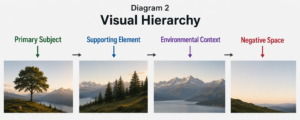
Visual hierarchy is the intentional arrangement of elements so the viewer naturally looks at the most important subject first, then explores supporting elements in a logical order.

A strong landscape composition generally contains:

  • Primary subject — the element that immediately attracts attention.
  • Supporting elements — features that strengthen the visual story.
  • Background context — environmental details that provide atmosphere without competing for attention.

When these elements work together, the photograph feels intentional instead of chaotic.

This concept is equally important whether you’re photographing a national park, an urban skyline, a luxury resort, or a commercial property.


The Difference Between Seeing a Place and Seeing a Photograph

Professional observation checklist before taking a landscape photograph.
Diagram showing how photographers analyze light, shapes, patterns, and perspective.

One of the most valuable skills professional landscape photographers develop is learning to stop seeing landscapes as places.

Instead, they begin seeing:

  • light
  • shadow
  • shape
  • line
  • texture
  • pattern
  • contrast
  • color harmony
  • visual weight
  • negative space
  • perspective
  • depth
  • relationships between objects

Before unpacking a tripod, experienced photographers often spend ten to fifteen minutes simply observing.

They ask themselves questions such as:

  • What naturally attracts my eye?
  • Where is the strongest light?
  • Which elements create visual balance?
  • Which objects distract from the story?
  • Can I simplify this composition?
  • Would a telephoto lens isolate the subject better than a wide-angle lens?
  • Does changing my position improve perspective?
  • Should this image be horizontal, vertical, square, or panoramic?

These questions transform photography from recording a location into designing an image.


Bigger Isn’t Always Better

Wide-angle versus telephoto composition comparison.
Illustration comparing how focal length changes landscape composition.

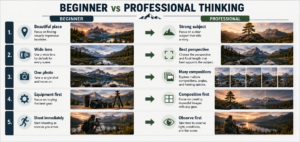
Many beginners instinctively reach for an ultra-wide lens because they want to include everything.

Ironically, this often produces weaker photographs.

Extremely wide focal lengths make distant mountains appear smaller than they looked in person. Foreground objects dominate the frame while the dramatic scenery recedes into the distance.

Professionals rarely ask,

“How much can I include?”

Instead, they ask,

“How much can I remove?”

This philosophy explains why many respected landscape photographers frequently use moderate telephoto lenses. Compressing perspective often simplifies complex scenes, eliminates distractions, and strengthens visual relationships between distant subjects.

There is no universally correct focal length.

The right choice depends entirely on the story you want your photograph to tell.


Professional Tip

Before taking your first photograph, spend at least 10 minutes exploring the location without your camera.

Walk 50–100 feet (15–30 meters) in different directions. Crouch lower. Climb slightly higher. Compare the scene with a wide-angle lens, a standard focal length, and a telephoto lens.

Many award-winning landscape photographs are created by moving the camera only a few feet.


How Do Professional Photographers Choose a Landscape Subject?

One of the strongest lessons inherited from classic landscape photography remains just as valuable in the digital age:

Every successful landscape photograph needs a clear subject.

Choosing a clear subject in landscape photography.
Examples of simple subjects that create stronger landscape compositions.

Without one, viewers admire the scenery briefly before moving on.

Fortunately, the subject doesn’t need to be spectacular.

Professional photographers frequently build compelling compositions around surprisingly ordinary elements:

  • a single tree
  • an old fence
  • weathered rocks
  • morning mist
  • reflections in still water
  • sand dunes
  • driftwood
  • wildflowers
  • a winding trail
  • a lone cabin
  • dramatic cloud formations

What matters isn’t how famous or dramatic the subject is.

What matters is its ability to organize the composition.


Build Visual Hierarchy

Diagram explaining primary subject, supporting elements, and background.

Building visual hierarchy diagram.

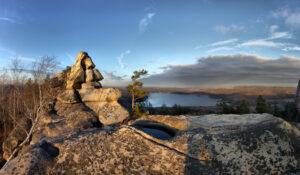
Classic film-era landscape example.
Historic landscape photograph illustrating depth and visual hierarchy.

Professional photographers mentally divide every landscape into levels of importance.

For example:

Primary subject

A mountain peak.

↓

Supporting element

A river leading toward the mountain.

↓

Background

Clouds illuminated by sunrise.

Each layer strengthens the story without competing for attention.

This is one reason vacation photographs often feel cluttered. The photographer tries to include every interesting object instead of allowing one visual element to dominate.


Eliminate Visual Noise

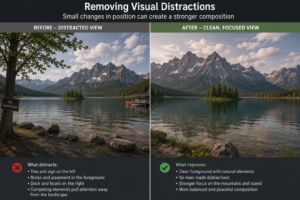
Removing visual distractions from a landscape composition.
Example showing how changing camera position removes distracting elements.

Visual noise has nothing to do with digital image noise.

Instead, it refers to anything that distracts attention from the primary subject.

Examples include:

  • utility poles
  • road signs
  • parked vehicles
  • random branches
  • footprints
  • litter
  • bright rocks
  • distracting fence posts
  • clipped tree trunks
  • bright patches of sky
  • people unintentionally entering the frame

Professional photographers constantly inspect the edges of the frame before pressing the shutter.

Many experienced photographers spend more time checking what shouldn’t appear than what should.

One distracting branch touching the corner of the frame can weaken an otherwise outstanding composition.


Learn to Simplify

Simple minimalist landscape composition.
Example of simplifying a composition by removing unnecessary elements.

One of the defining characteristics of professional landscape photography is simplicity.

That doesn’t necessarily mean minimalism.

It means every object inside the frame has a purpose.

If an element doesn’t contribute to the story, remove it.

Sometimes this means changing your position.

Sometimes it means waiting for people to leave.

Sometimes it means using a longer focal length.

Sometimes it means cropping differently.

The goal is always the same:

Reduce visual competition so the viewer immediately understands the photograph.

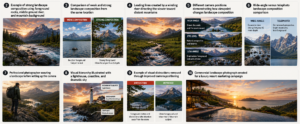
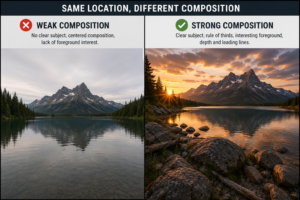
Comparison of weak and strong landscape compositions.
Side-by-side comparison demonstrating improved composition from the same location.

Work the Scene Instead of Taking One Photograph

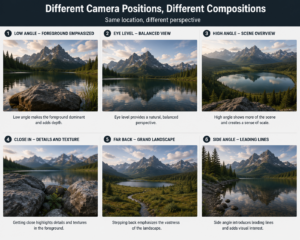
Camera position comparison.
Illustration showing how viewpoint dramatically changes landscape composition.
Professional landscape workflow illustration.
Diagram showing photographers exploring multiple viewpoints before making the final exposure.

A common beginner mistake is arriving at a beautiful viewpoint, setting up a tripod immediately, making one exposure, and moving on.

Professionals rarely work this way.

Instead, they work the scene.

This means exploring multiple possibilities before settling on the strongest composition.

A typical professional workflow includes:

  • walking around the subject for 15–30 minutes
  • photographing from standing height
  • lowering the camera close to the ground
  • trying eye-level compositions
  • moving farther away
  • comparing wide-angle, standard, and telephoto focal lengths
  • experimenting with foreground elements
  • checking edge distractions
  • waiting for changing weather
  • returning later if the light improves

During commercial tourism assignments, it’s common to create dozens of exploratory compositions before producing the final photograph selected by the client.

The image that eventually appears on a magazine cover, hotel website, or destination marketing campaign is usually the result of dozens of deliberate refinements—not a single lucky exposure.


Professional Workflow Checklist

Before committing to your final composition, use this professional checklist:

  • ✓ Identify one unmistakable subject.
  • ✓ Remove distracting elements.
  • ✓ Walk around the scene before setting up your tripod.
  • ✓ Compare multiple focal lengths.
  • ✓ Inspect all four edges of the frame.
  • ✓ Check for overlapping objects in the background.
  • ✓ Look for foreground elements that create depth.
  • ✓ Compare horizontal and vertical compositions.
  • ✓ Capture several variations before moving on.
  • ✓ Review the histogram only after the composition is finalized.

Notice that exposure comes last.

Professional photographers almost always solve composition before worrying about camera settings.

A technically perfect exposure cannot rescue a weak composition.

A strong composition, however, can remain visually compelling even under less-than-perfect lighting.

StepStagePurposeKey Actions
1Research LocationFind the best shooting location.Study maps, satellite imagery, access roads, viewpoints, foreground opportunities, and potential compositions.
2Weather ForecastEnsure favorable conditions.Check cloud cover, wind, precipitation, visibility, temperature, and atmospheric conditions that match your creative vision.
3Sun PositionPlan the best light.Use sun-tracking apps to determine sunrise, sunset, Golden Hour, Blue Hour, and the sun’s direction at your location.
4Arrive EarlyPrepare before the best light begins.Reach the location ahead of time, unload equipment, scout, and be ready when conditions become ideal.
5Scout LocationExplore composition possibilities.Search for strong foregrounds, clean backgrounds, leading lines, reflections, textures, and unique viewpoints.
6Build CompositionCreate depth and balance.Arrange foreground, middle ground, and background. Apply composition techniques such as the Rule of Thirds, leading lines, framing, symmetry, and visual balance.
7Camera SettingsOptimize image quality.Select appropriate aperture, shutter speed, ISO, white balance, focus mode, and exposure settings for the scene.
8Capture VariationsMaximize creative options.Shoot multiple compositions and exposures. Try different focal lengths, focus points, orientations, and exposure brackets.
9RAW EditingRefine the final image.Import RAW files, cull the best images, adjust exposure, contrast, color, white balance, sharpening, noise reduction, and local edits.
10Final DeliveryPrepare images for publication.Export high-quality files for web, print, clients, or portfolio, applying appropriate resolution, color space, and file format.

Continue Learning

Landscape composition is only one part of creating professional landscape photographs. Once you’ve learned how to build stronger compositions, the next step is understanding how light, camera settings, and field workflow influence the final image.

Future articles in this series will cover:

  • Landscape Photography Lighting: How Professionals Work with Natural Light
  • Landscape Camera Settings: Exposure, Filters, and Professional Workflow
  • Night Landscape Photography: Moonlight, City Lights, Fireworks, and Long Exposure Techniques

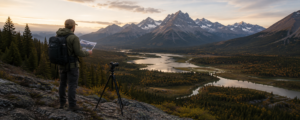
Professional photographer composing a mountain landscape during sunrise using a tripod and mirrorless camera

Frequently Asked Questions


What makes a strong landscape composition?

A strong composition has a clear subject, visual hierarchy, depth, and supporting elements that naturally guide the viewer through the frame. Read the full explanation.

What is visual hierarchy in landscape photography?

Visual hierarchy organizes the scene so the viewer notices the primary subject first, then supporting elements, and finally the background. Learn more.

How do photographers create depth in landscape photography?

Professionals build depth by arranging foreground, middle ground, and background. See the section.

Should I use a wide-angle or telephoto lens?

Read the comparison.

How do professionals choose a landscape subject?

See the section.

What is visual noise?

Learn how to eliminate distractions.

Why is simplicity important?

Read more.

Why does camera position matter?

See the explanation.

What is the professional workflow?

View the checklist.

What is the biggest beginner mistake?

Read more.


Previous Post
Industrial Macro Photography: How to Photograph Machine Parts and Engineering Components
Next Post
What Time of Day Produces the Best Landscape Photos? A Professional Guide to Natural Light
Landscape Photography Camera Settings: Exposure, Filters & Pro Workflow

Landscape Photography Camera Settings: Exposure, Filter…

21 hours ago
Landscape Photography Composition: Professional Techniques for Better Photos

What Time of Day Produces the Best Landscape Photos? A…

2 days ago
Industrial Macro Photography: How to Photograph Machine Parts and Engineering Components

Industrial Macro Photography: How to Photograph Machine…

4 days ago
Let’s Connect
Facebook
Twitter
Pinterest
Instagram
Telegram
37 West 26th st. NYC, NY 10010
gatsbystage@gmail.com
347-858-5857
Fill out this field
Fill out this field
Please enter a valid email address.
Fill out this field
ARTIST HEADSHOT
COMMERCIAL SHOOT
MODEL TEST
INTERIOR SHOOT
ACTOR HEADSHOT
MEDICAL HEADSHOT
INDUSTRIAL SHOOT
BUSINESS SHOOT
MUSICIANT HEADSHOT
ONLINE REMOTE INTERVIEWS
POSCAST / INTERVIEW REC
GREEN SCREEN PRODUCTION
PHOTO STUDIO RENTAL
VIDEO STUDIO RENTAL
BLOG
REQUEST
STUDIO POLICY
PRODUCTIONS

          Useful information about working in the studio from the blog

+1 (347) 858-5857
37 W 26th St studio 315, New York, NY 10010
2025 All Rights Reserved